In school we had a class in C programming. I looked at the screen, looked at the syntax, and told myself I couldn't do this.
So at 17, going into undergrad, I picked biology.
Nobody stopped me. I didn't fail a test. I just decided who I was, and programming wasn't part of it. That was the end of that conversation, for years.
"I'm not a programming person."
It felt like self-knowledge. It felt honest. I think it's the most expensive thing I've ever said to myself.
Two sentences that sound the same
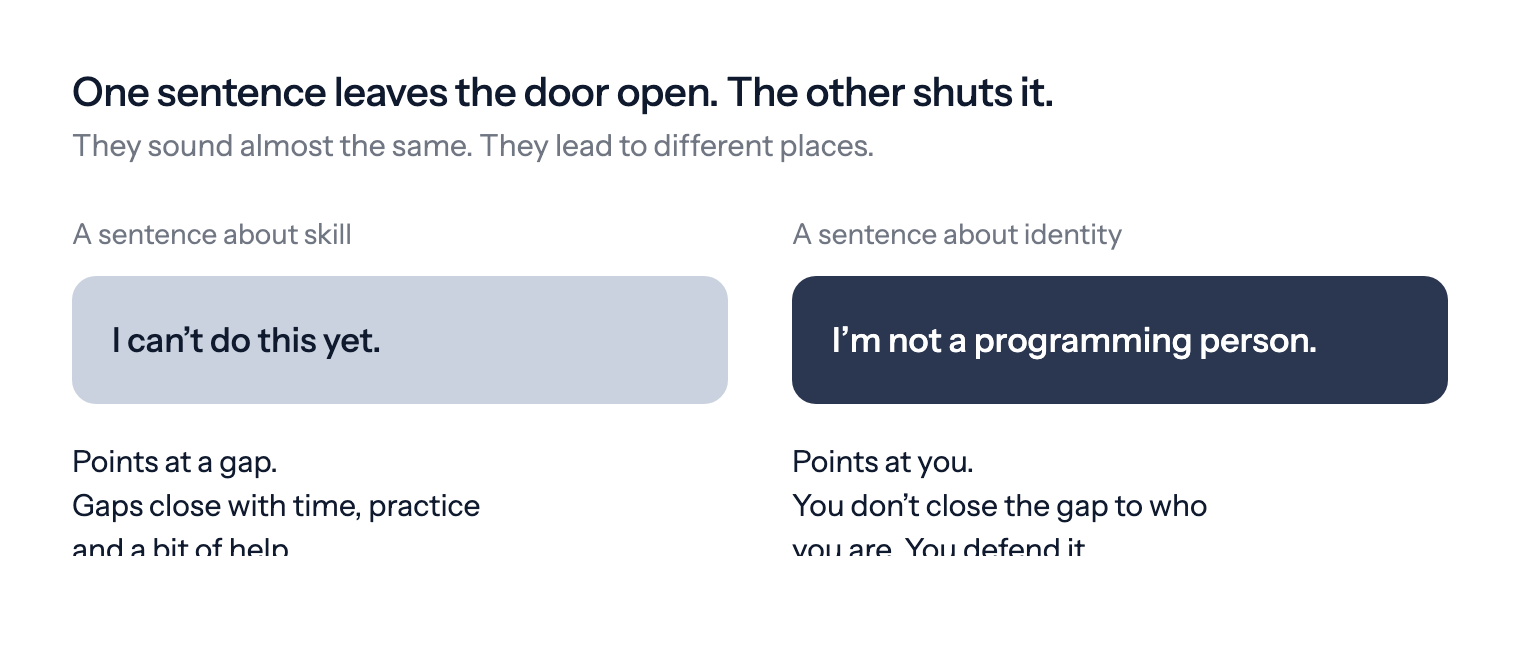
"I can't do this" and "I'm not this kind of person" sound almost the same. They aren't.
"I can't" is about skill. It points at a gap. Gaps close with time, practice and a bit of help, and "I can't yet" is sitting right there waiting.
"I'm not" is about identity. It doesn't point at a gap. It points at you. And people don't work to close the gap between themselves and who they are. They defend who they are.
Where the sentence comes from
It never felt like I'd picked that sentence up from anywhere. It felt like something I'd found out about myself. But some fields hand it to you.
In 2015, the philosopher Sarah-Jane Leslie and her colleagues surveyed academics in 30 fields. They asked how much success in each field depends on raw talent, the kind you can't teach. The fields that said "a lot" had fewer women earning PhDs. Their point wasn't that talent is real or fake. It was that the belief itself keeps people out. If a field says you have to be born with it, and you don't feel born with it, the door looks shut before you've touched it.
Programming has that reputation. You've either got the brain for it or you haven't.
Then you have to pick what to study, at an age when you have no idea what you're deciding. I picked mine after one look at some C.
The sentence keeps itself true
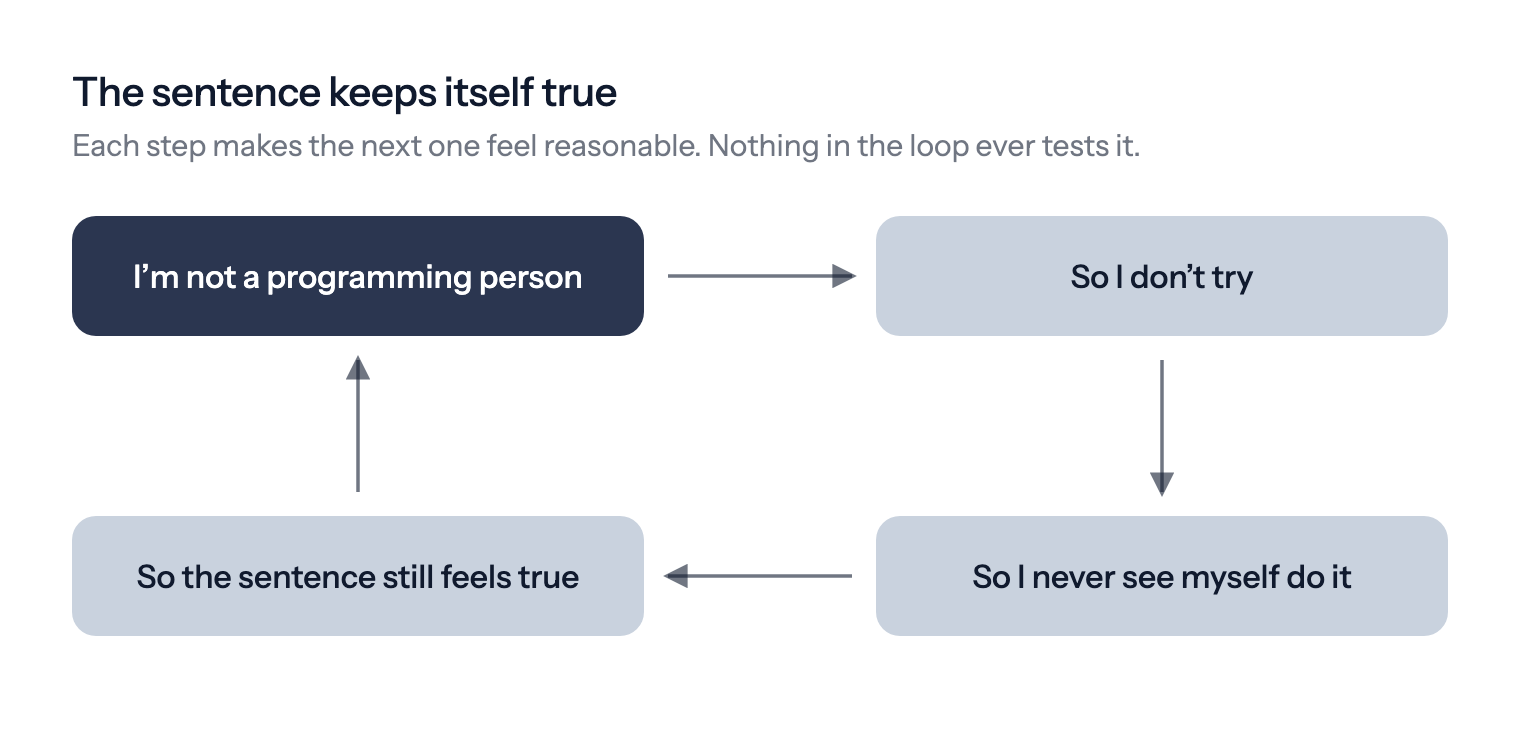
This is the part that took me years to see. Once you've said it, the sentence protects itself.
If I'm not a programming person, I don't try. If I don't try, I never see myself do it. If I never see myself do it, the sentence still feels true. Round it goes.
It can even hide what you already know.
Researchers at GFLEC, the financial literacy centre at George Washington University, ran a simple test with Dutch households. People answered a few basic questions about money, once with an "I don't know" option and once without it. Women picked "I don't know" far more often than men. When that option was taken away, many of those same women picked the right answer. The researchers put roughly a third of the gender gap in financial literacy down to confidence, not knowledge.
So part of the gap wasn't missing knowledge. It was the label getting there first. "I'm not a numbers person" answers the question before you've read it.
What broke it for me
I didn't argue myself out of it. Nobody gave me a pep talk. I ran into a problem.
I did a master's in marine science in Australia. A lot of the field work looks like this. You're snorkelling with a slate, a laminated sheet with a pencil tied to it, trying to write down what you see. You look down to write, look back up, and the waves have pushed you 20 or 30 feet. You swim back. You do it again. All day.
On Orpheus Island, off the Queensland coast, we practised line transects. You lay a 50 metre tape along the seafloor and record everything along it. My dive partner, a good friend, did the hard part. He duck-dived 6 or 7 metres to plant the tape. I couldn't dive that deep, so I stayed up top with the slate, getting dragged around by the current.
That's how reef surveys have been done for decades. People in the water with pencils.
Around Christmas 2022, ChatGPT came out. I was far from home and deep in my master's. I had time, and I had questions. The slate stuck with me. There had to be a better way.
So I started learning to code. Not C. Whatever the problem in front of me needed. The basics first, then training models, automation, command line tools. I played around with Rust. I wrote on Medium about how marine science gets funded and how it could work better, and that writing is how Flying Fish Technologies found me. They're a Brisbane company that builds underwater gliders for ecological surveys. I did data analysis for them, working through survey footage from Hawaii and the Red Sea.
Then I built FishTally with a co-author, a bioscientist. It finds and counts fish in video: the counting I used to do by hand on a slate. It's up on SSRN as a preprint.
That was the first time code really clicked for me: getting vision models working for FishTally, counting fish in video.
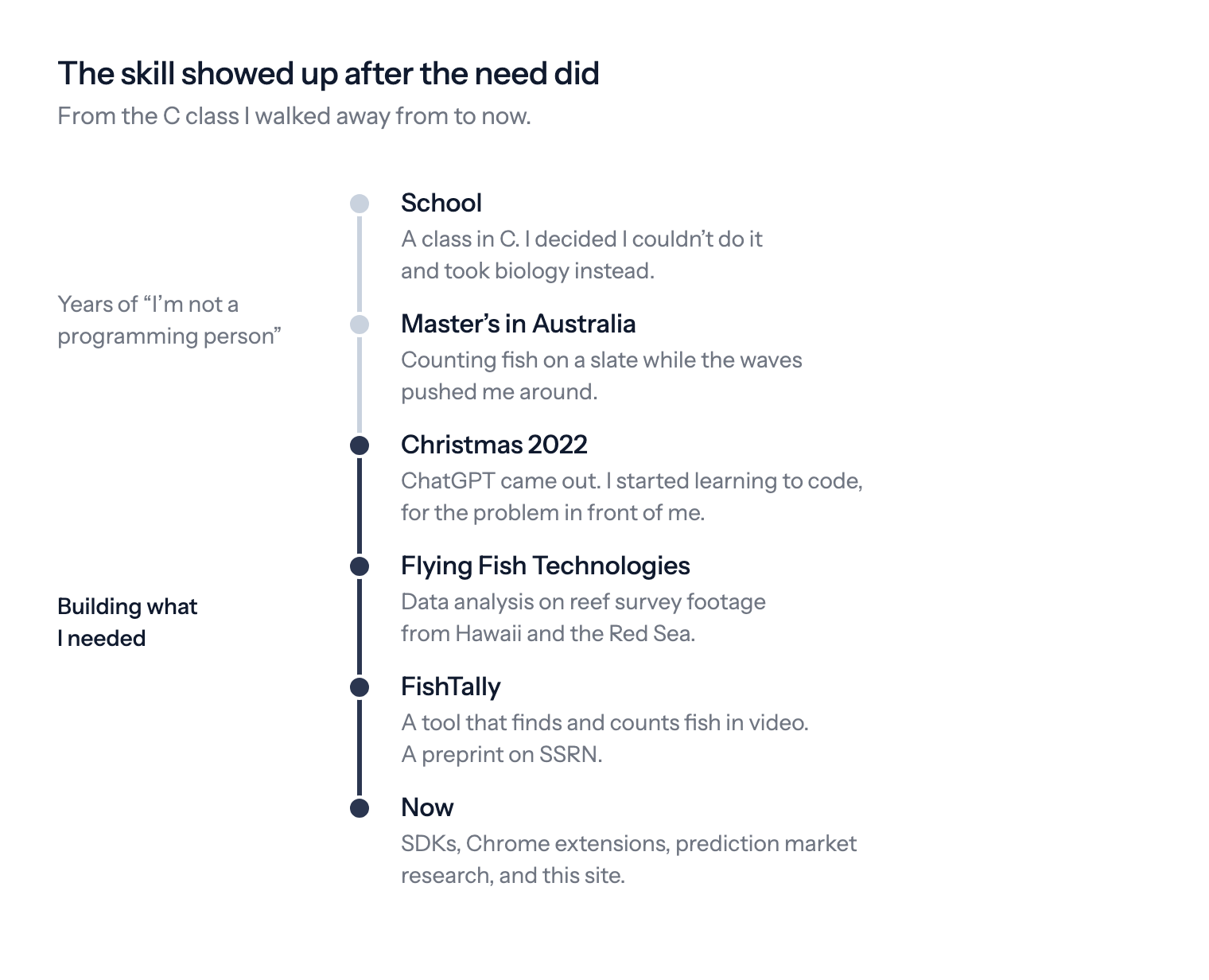
Look at the order. The skill didn't come first. The need did. I wanted to stop counting fish on a slate, and that need was louder than the sentence. Once I'd started, the sentence just stopped mattering.
I'm still not a programming person
These days I ship SDKs in TypeScript and Python. I build Chrome extensions. I do my prediction market research in code, and I built this site.
And I still wouldn't call myself a programming person.
That isn't modesty. Swapping the label doesn't get you out of the trap. "I'm a programming person" needs defending just as much as "I'm not" did. The first time something gets hard, it stops being a hard task and starts being a threat to who you are.
I didn't become a programming person. I became someone who programs when something needs building.
It isn't only programming. Design, development, the engineering work I do, the creative work I do. I don't hold one fixed label for any of it. I am stateless. In code, that means nothing carries over from the last run. Each job starts fresh.
A lot of advice that sounds wise makes this worse. Know yourself. Play to your strengths. Stay in your lane. Knowing yourself is useful. Defining yourself is where it goes wrong. Once self-knowledge hardens into a definition, you stop learning who you are and start defending who you were.
The cost you can't see
I can't put a number on what that sentence cost me. I don't think anyone can. How do you count the things people never tried?
It's every "I'm not a math person", "I'm not a finance person", "I'm not technical", "I'm not creative". Each one feels like honesty. Each one closes something, usually early and usually quietly.
What to say instead
I don't think the way out is believing in yourself. That's confidence painted over doubt. It might get you to try once, but it cracks easily.
The way out is plainer: need something badly enough that the label stops mattering.
The trap is made of language. "I'm not." A subject and a no. The way out is a sentence too, just a different shape.
Not "I'm not an X person."
Not "I'm an X person."
Just "this is what needs doing."
There's no "I" in it. Nothing for the label to hold on to.
A rewrite of "The Identity Trap", first published on Substack. Sources: Leslie, Cimpian, Meyer and Freeland, "Expectations of brilliance underlie gender distributions across academic disciplines", Science (2015). Bucher-Koenen, Alessie, Lusardi and van Rooij, "Fearless Woman: Financial Literacy and Stock Market Participation" (GFLEC working paper). FishTally paper: SoftwareX.